Wednesday, April 4, 2012

Color of Paradise

The Color of Paradise directed by Majid Majidi is about an blind boy, Mohammad, from Iran. The film contains a mix of melodrama and heart-wrenching moments within beautiful scenes of the Iranian countryside.
The sensitivity in some scenes is extraordinary and surprising. Particularly, when Mohammad finds a fallen chick in a pile of leaves, was a testament to how acute his sense of hearing is. Until the camera actually revealed the helpless bird, I was unsure as to what was happening. At points, Mohammad can be seen moving his fingers through the air and speaking so quietly he cannot be understood. These moments are a testament to how Mohammad understands the language of nature, perhaps more than a person with hearing could.

The beauty of both the artificial color and the raw nature depicted in The Color of Paradise really caught my attention. Seeing the girls and Mohammad's grandmother create dyes and hang saturated fabrics was perhaps my favorite moment of tactile imagery in the film. The variety of topography in Mohammad's world, is stunning. One particular wide angle shot of Mohammad and his father when they first journey back to their village through a field, showed the scope of the world in some ways he cannot experience. Even so, this is low on the list of reasons to feel for Mohammad's struggles.

His father's lack of love is so dissapointing. For such a hard working man, there is a definate conflict between understanding the father's problems and reconciling them with their effect on his own son.

Regarding the ending Stephen Holding in his NYTimes review of the film said that it has a, "wrong-note final image". I'm not too sure of this assessment. I do confess to rolling my eyes a bit at the dramatics of it all because it reminded me of Disney characters being brought back to life by tears or something to that effect. Another criticism might be that the sudden use of computer effects is too big a contrast to the rest of the film, which is more steeped in realism and nature.

Besides that, I found that the final message made sense, as we had been given a taste for the director's beliefs in God with the death of Mohammad's grandmother. Although certainly not as dramatic, she is filled with light and smiles, perhaps because she is greeting God or perhaps, as this image directly follows it, she is thinking of her precious grandson.

Again, I'm ambivalent if it was really 'a wrong-note'. The typical sound-scape of birds and nature is abandoned in the final moments in favor of a sweeping score. In this way, perhaps the filmmakers are ensuring the audience will either be given a positive outlook on the bleak situation or be pushed past the emotional breaking point. My view was entirely positive, although I can't help but wonder if the father's life will either be ruined for good or he'll try to become a better person...


One of my favorite elements of the movie was the terrifying noise in the forest that only the father seems to hear. It is almost like the cry of an animal but it is difficult to place and off-putting. Perhaps it is the supernatural sound of God or the Devil foreshadowing the terrible conclusion to the film. In fact, the first time the noise plays, he is shaving in front of the river, which becomes so central to the film later on. He cuts himself by accident and throws the mirror into the current. Such dreadful implications are a nice mix with the lovely elements of the story like Mohammad's friendship with the girls, and his interaction with the world around him.


-Claudia

Wednesday, March 28, 2012

Annie Hall

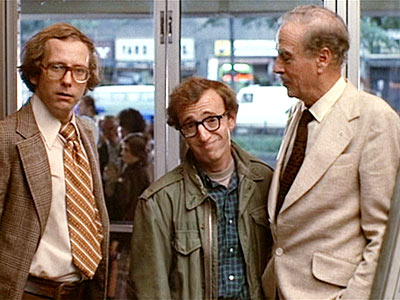
Woody Allen's Annie Hall is a witty and almost dream-like film. Filled with fantasy, reality and humor Allen makes so much out of a film where people mostly walk and talk. In fact, Roger Ebert wrote in his Great Movies column that the character of Alvy Singer, "lives in order to talk about living", which I think is exactly right.


But this is so movie is so much more than talking, as wonderful and hilarious as the dialogue is! One of Annie Hall's great strengths is that its structure is varied and engaging. From the first three scenes it is obvious that Allen's film is taking a unique approach to storytelling. The opening titles (which, I'm counting as the first scene) are completely silent with no flashy graphics, only a simple black background and white text. Then Alvy looks straight at the viewer, much like in his stand up performances, and begins to talk.


This spare beginning sets up what the film will consistently deliver, talking about relationships. This uncomplicated premise leaves room for creativity in the way the film is presented. Many of the scenes are flashbacks and most have atypical framing, such as the first scene where Alvy and his friend are walking down the street in a conversation. At first, they are barely visible, if at all, and slowly they come into the frame. Here, the camera is waiting for the actors to catch up and it creates a confusing experience of the viewer trying to find who is speaking. This puts the emphasis on what is being said rather than on what is seen. Annie Hall's dialogue is perhaps more important than some of the imagery. The viewer is taught by this framing to roll with the punches of Annie Hall's unconventionality.

I particularly enjoyed Annie Hall's confidence in directly addressing the viewer in scenes like the line in the movie theater, where Alvy looks right at us and says, "Boy, if life were only like this!"At another point, characters argue whether the story they are telling is correct and speak as if they are actively concerned with what the viewer is hearing. These breaks give the movie a kind of spark and humor. It is almost as if we are also engaged in the making of this movie and the film is not complete without those who see it, otherwise Alvy speaks to no one in more ways that one.


The failure of a traditional love story between Alvy and Annie is explored thoroughly in the film. Alvy and Annie break up and get back together but by the end of the film the two of them decide to share their memories over coffee and go their separate ways. I first thought Annie Hall would be a film about "what went wrong" in their love life but I saw it more as the stories Alvy and Annie were sharing with each other at the end of the film. They show the good times, the bad times and their sense of humor through it all. In fact, in one scene Alvy and Annie are walking through their memories and commenting on what they think of themselves now. The whole of Annie Hall is like this one scene.

As Ebert wrote about dialogue in Annie Hall in the same article previously mentioned, "This is not merely dialogue, it is a double act in the process of discovering itself" This is essentially the reality of the relationship between the viewer and the film. The art is created in order to exist in the interpretation of an outside source.

Amicably returning to their memories shows how although they lost their love for one another, they simply turned into friends....or just two people with a lot of history together! (if they never spend time together again) For all of Alvy's reminders of death and the misery of life, this view of relationships is quite positive. There is no hate for one another, just differences to talk about.

-Claudia

Wednesday, March 21, 2012


Petrel Hotel Blue is a surreal crime film by Koji Wakamatsu. It is a tale of revenge. The beginnings of the film point to a more conventional story of criminals sent to jail for robbery. Some of the cohorts abandon the plan before it even starts. There are elements of greed, loyalty and revenge all which point the main character to the Cordon Bleu café where his unreliable former partner in crime works.
            There he meets Rika, a silent chain smoker, sitting at the bar of the Cordon Bleu in all of her mysterious glory. Men in the film are attracted to her inexplicably. Perhaps this is a supernatural talent of hers, as she seems to be a ghost. She is in fact the owner of the Cordon Bleu’s reason for staying away from the crime his friends were planning.
            The criminal’s motivations disappear after he deals with his disloyal friend.  Rika’s spell is cast over him and he becomes docile and hard working at the café. Only when suspicions by other men arise, does trouble come back to him. Men fight and kill over the beautiful Rika and her answer to this is that they are fools.
           
            I believe one central theme of the film is control. The film begins with a main character who holds incredible power over his followers so much so that one might give away their month’s earnings to him. The man who owns the Cordon Bleu would rather keep control over a respectable life and at the same time he is held captive by the desire he has for Rika and her otherworldly power over him.
            Wakamatsu's earlier works follow the theme of women being controlled by men. For example, in his film The Embryo Hunts in Secret from 1966 a man rapes and tortures his girlfriend until she breaks free from his captivity and kills him. As Wakamatsu himself explains, "...violence, the body and sex are an integral part of life" These ideas are explored in Petrel Hotel Blue as well. Rika is treated as simply a body and an object of sexual desire. She inspires a kind of hardworking ethic in the men she hypnotizes. They will do anything to keep her, even kill for her sake. Perhaps the funniest moment of the film is when a police officer shoots and kills a man for spying on Rika swimming naked. His reasoning is that "peeping is a crime" even though he himself was doing the same moments earlier.
             This kind of convenient morality and switching of character types is an interesting aspect of this film. The main criminal goes from the tough as nails type to a bartender diligently sweeping up his café. Rika creates a submissive character out of a once dominate force. Perhaps this extreme control she has over men is a reflection of her past.
             Although it is never explicitly explained, one can assume Rika is a ghost. Also, from the two separate instances when men approach an old woman on the road leading to the Cordon Bleu, Rika's form is confusingly cut between shots of the old woman. She explains that she was brought to the area as a girl and has been there ever since. Perhaps this is Rika's story. As she disappears into a gravestone at the end of the film one can assume from her clues that she might have been murdered or forced to live in the area, by men?, until her death.
             Despite the fact that the film beings with a criminal's revenge story, I believe that the main act of revenge is perpetrated by Rika. Somehow she haunts the area where she died and captivates men, leading them to their deaths. Men fall for her sexual charms and mysterious nature and she punishes them for this blind desire.


Wednesday, February 29, 2012

Crouching Tiger Hidden Dragon

Crouching Tiger Hidden Dragon (2000), directed by Ang Lee, as each film so far has done, shows a different side of love. It's perhaps closest to the message we've seen in Lady Chatterly. I think that Lady Chatterly's message is about love being one with nature and it transcends social/economic boundaries as well as human laws. Crouching Tiger shows what happens when one doesn't accept this and becomes selfish and concerned with material objectives.

All three of the main characters have goals centered around power and society. Yu Shu Lien submits to the patriarchal society and follows the strict moral codes within it, even at the expense of her emotions and desires. Mu Bai also focuses on selfish concerns, only involving himself in the pursuit of wisdom and teaching others while he denies his feelings just as Shu Lien does. Lastly, Jen is driven to power and freedom within the Wudan and the Green Destiny. This choice also keeps her from experiencing love with the desert bandit Lo so she can concentrate on being the greatest warrior.

At the end of the film, Mu Bai has been poisoned by his enemy Jade Fox and is preserving his energy until the antidote is retrieved by Jen. By his side is Shu Lien, devoted to him to the end, reminding him not to waste energy by talking. Mu Bai confesses to her that he loves her and that because he never acted on these feelings he has "already wasted my life". This character, Mu Bai, who had been a pillar of wisdom throughout the film, finally sees what is truly important. Shu Lien realizes that denying your true feelings can be the biggest regret of your life. This is wisdom she imparts to Jen, who arrives with the antidote too late.
                                                   Shu Lien and Mu Bai's first and final embrace
Jen sees that the search for power is filled with revenge and death as her former mentor Jade Fox reveals with her dying breath that her true intent was to kill Jen. Fox tells her that Jen's selfish pursuit of excellence was a betrayal and that the real poison in this world is, "the deceit of an eight year old girl". These revelations change Jen's point of view and show her that her quest for freedom cannot be selfish.
                                                                        A quest for power gone too far
Jen's leap off of Wudang Mountain is symbolic of her transcending her earthly desires, letting go of a love to Lo that would hinder her freedom and letting go of her journey to master the Wudan. Her embrace of death is the ultimate powerlessness and an atonement for her selfish desires.

If letting go of personal want and human law is paramount , the film sugggests that love does not deny others. Mu Bai and Shu Lien both denied their feelings in order to conform to society, which resulted in regret and tragedy. Jen denied both Jade Fox's desires and Lo's love in search of her own personal goals, which resulted in betrayal and lonliness. As Lady Chatterly's message is not to deny one's self, Crouching Tiger's message is not to deny others.

On another note, I really enjoyed this film for it's portrayal of women as complex and central characters. Although her ambition goes a bit off the rails by the end of the film, Jen's fight against a restaurant full of male warriors was extremely exciting to watch. Jen and Shu Lien are friends to a certain extent, although they have their dissagreements, and the viewer isn't forced to choose one woman or the other, as a lot of entertainment would have you believe is neccesary. Even the terribly unlikeable Jade Fox isn't just evil for evil's sake. She was denied by the sexist society and betrayed by her only friend. We aren't made to like Fox, nor is she demonized. She is a sympathetic and complex character like the rest.

The women in this film are all dealing with the mobility and male privlege that society does not grant them. Although I am satisfied with the film's ending because the movie is so well made, I wonder about the conclusions that can be drawn from the fate of all three women. Jade Fox dies as a result of being told she isn't good enough, both by men and by her ambitious pupil. Her death, I think is less problamatic than that of Jen's because Jade Fox commits murder to right a wrong. Jen, however, desires freedom and in her journey to the top rejects social conventions. Unlike Fox, she does have the power and capability to break gender barries and wield the Green Destiny. Her efforts are met with tragedy and, by the film's message of caring for others, she bears the burden of what her actions have caused. Jen's fate is to die. Although her death is highly symbolic and a tie back to legends Lo and herself spoke of in their past, the film suggests that women who fight for their freedom are great and all, but they have to die. Sure Mu Bai dies as well, but his life is marked by inaction, which is perhaps more reprehensible than Jen's very active characteristics. She fights for what she believes belongs to her whether it be a jade comb or the Green Destiny. For all of Crouching Tiger's progressive features, does this film promote that women with ambition should be cut down at the last minute?

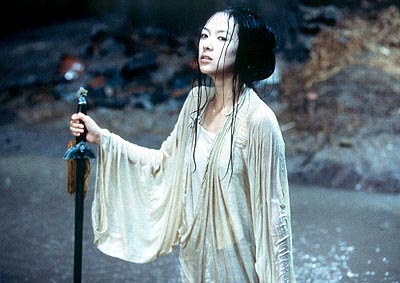
                                                                                   The Invincible Sword Goddess


-Claudia

Wednesday, February 15, 2012

Biutiful

Film Watched: Biutiful dir. Alejandro Iñárritu

This is quite the heavy picture. It was very atmospheric with not too much levity, and it presents some very striking images and horrific moments. Not a film to watch if you're in a bad mood and if you are feeling good, get ready for that to end.

There are some beautiful scenes featuring Uxbal and his children! And then lots of death and despair.

The film prepares the viewer with clues shown throughout for the death of the main character, Uxbal. Which is what I will be exploring in this post more than anything else. There is a certain 'language' or style to death in Biutiful. The first possible aspect of this of this is that the dead must somehow converse with the living before they can move on. There are at last two examples of this.

  • when the ghost of a dead boy confesses his sins and the second is when the elderly man describes his death to his loved one. When Uxbal dies he finishes his conversation with his daughte. It seems to be his only loose end, the only thing unfinished in life. 
  • The spirits of the dead rise to the ceiling, which is perhaps first exibited through the moths and secondly through the bodies of the workers. Uxbal experiences this before he makes it to the bedroom. 
  • Those who have died can be seen in mirrors. Perhaps this is merely to emphasize the presence of a spirit because they cannot be seen outside of the mirrors in some shots, but it seems to be attached to the lore that Biutiful creates for the spirits of the dead.
The structure helps the film reveal many key points in the story in the story but guard their full meaning. The first time we see the man speaking to Uxbal in the forest we do not know his identity. In the beginning we are led to believe the father and daughter continue their conversation naturally, which we later realize, because of the change in perspective, is only half-true. He dies in the middle of their dialogue but she doesn't notice for two reasons.

  • She is fixated on her mother's ring which they were both admiring on her hand. 
  • She seems to have inherited her father's psychic or telepathic abilities and can continue the conversation with his spirit.

The film has been criticized for being too heavy handed and overly grim. As one reviewer points out, the film can give one, "a true overdose of the tragedy of the human condition". I found this to be the case where the Chinese factory owner, Hai, was murdered by his lover/business partner, Liwei. Compared to the death of the innocent immigrants this seemed no where near as important and a little bit overkill. It lacked the gravity that the other dramatic moments of the film had. Of course we know he's paranoid about someone talking, but to actually murder him? It seemed like an extreme moment used to nail in the idea that terrible things happen in life. Although the structure of the film is played with briefly (the beginning and the end) it remains comprehensible. One review described the film as Uxbal's "death march", which is essentially what the film captures. For the entire film, we know Uxbal as a man dying. The film explores the final struggles of a dead man walking.


-Claudia

Wednesday, February 8, 2012

Lady Chatterly Discussion

So in relation to what we discussed about Lady Chatterly in class I'd like to focus on a few points made that I thought were interesting. The first is that many people were describing Constance and Clifford's relationship as "traditional" but as two classmates pointed out, this is simply one perspective.


One classmate from Delhi pointed out that our view of their relationship is one that is a Western and American idea of traditional. Another classmate grew up in America, but in a household full of women so his perspective on this relationship that Constance is breaking free from wasn't that it was a traditional kind of situation. I think people expect that automatically Constance and Parkin being together because they fall in love would still be a kind of abnormal situation because of our own society's views on relationships. As the other students pointed out the ideals of love and relationships might not be so universal even though one of the main themes of the film is nature. I mention nature just because it seems like "the natural way to be" that would be universal.

Seeing the earlier version of Lady Chatterly's Lover was very funny. Immediately the class started laughing when the main menu of the DVD appeared because it featured Constance and Parkin who, in this version of the film are blonde, above average looking and giving the camera smoldering looks of desire. It brought to mind how subtle the French version of the film is.


                                                            Who are they looking at?

In Lady Chatterly (2007), the social and economic divides are important. However, in the 1993 serial these themes are beaten into the viewers minds as if we are not capable of inferring ideas presented to us in a less obvious manner. Perhaps because it was a made for TV film it was taken into consideration how the average viewer might be doing things with the TV on. So to make up for perhaps a less critical viewer, the creators of the film were less concerned with artistry and provoking thought.

The 1993 version of the film lays out the themes and characters on a silver platter with no room for interpretation. They are completely formed as characters and not as people. This approach not only gives the appearance of a soap opera but also distances the work from the audience. How could one possibly relate to this Constance, and this Parkin? Sure it's entertaining to watch an affair blossom but these shortcomings date the work and encourage disbelief in the story it's presenting.

-Claudia

Wednesday, February 1, 2012

Week Two Lady Chatterley

Week Two:

Film watched in class- Lady Chatterley (2007), Pascale Ferran


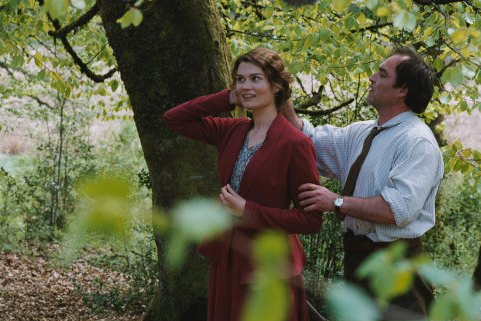
Lady Chatterley is a film that explores sexuality and nature. The owner of the Wragby estate, Sir Clifford Chatterley, is left disabled from an injury sustained in WWI. Clifton gives his wife, Constance, an encouraging speech on the forest filled grounds of their estate. He suggests that she find lovers who can please her in ways Clifton cannot. Constance is outraged at the thought of this and rejects the idea. As she later explains in her diary, "Sexual desire is the worst form of egoism."

The season is fall and the grounds of Wragby are introduced with shots of the clouds, the tops of trees and finally, Constance herself. This visually sets up the themes of the film, that of nature and the body.

In stark contrast to her slender form amongst the trees, we hear Clifton's mechanical wheelchair roaring over the classical film score. His presence is one separate from nature and humanity although his motives in the beginning seem more noble.

When asked to see the gamekeeper, Parkin, one afternoon, Constance stumbles upon the man himself bathing by the side of his cabin. Constance is extremely embarrassed and intrigued. She quickly finds a place where she can collect herself and still examine the gamekeeper's form.

Later that night Constance prepares for bed, which is located in a separate room from her husband. She sees herself in a mirror and undresses. Constance considers her naked body for a moment and then puts on her nightgown and goes to bed. In the middle of the night she wakes from a terrible dream and clutches her chest. Perhaps she dreamt of the gameskeeper and is physically affected by these new ideas of desire.

As Constance explores the grounds, where she seems to walk almost daily, she decides to spend time at Parkin's cabin in order to enjoy nature. She explains to him that it is beautiful and peaceful at the clearing where the cabin is and while he labors she sits back and relaxes.

Time passes and Constance and Parkin become more friendly. A pivotal moment occurs when they are tending to the newborn chicks in a chicken coop. As Constance holds a chick in her hand she remarks on how trusting it is and she begins to cry. She sees an admirable and natural quality of trust, so second nature to such a young being. However it is an aspect that she is separated from as she is not in touch with her sexuality. She merely flirts with it by enjoying nature on her walks around the forest which in A.O. Scott's review of the film describes as, "the sensuality of sunshine, wildflowers and fresh air." But she has never  before allowed access to the natural aspects of her own body. This is where Constance and Parkin connect and quickly have sex in the cabin. Their affair has just started.


An interesting aspect of their courtship is the formality of their sexual experiences in the beginning. They enter the cabin and do not disrobe. He only removes her stockings and underwear and the event lasts only a few awkward minutes. With each time they have sex, they ironically become more open to intimacy. A. O. Scott describes this journey as one that shows "how sexual chemistry can turn into love." Their removal of clothes is ritualistic and more is revealed with each interaction.

This slow reveal of each others bodies shows their strengthening bonds and trust for each other. Parkin is skeptical that Constance would find his body as appealing as he finds hers to be. Constance assures him that she has the desire to touch him. The night before Constance leaves on a vacation she asks to see him fully naked in front of her before he extinguishes the lights. This indulgence is a far cry from the Constance the audience is originally introduced to, proclaiming that, "Sexual desire is the worst form of egoism."

Another important moment occurs when Constance runs naked through the field and forest while it rains. She cries out to the skies and dances around freely. Parkin is infected by her joy and does the same. When they reenter the cabin they make crowns of leaves and branches. They decorate themselves with flowers all over their nude bodies. Their appearance and king and queen of nature is reminiscent of Adam and Eve in the Garden of Eden. They are able to return to a state where Adam and Eve were without shame. The pair are openly experiencing nature with no embarrassment towards their sexuality. It's a scene depicting a true marriage between nature and sex.


-Claudia