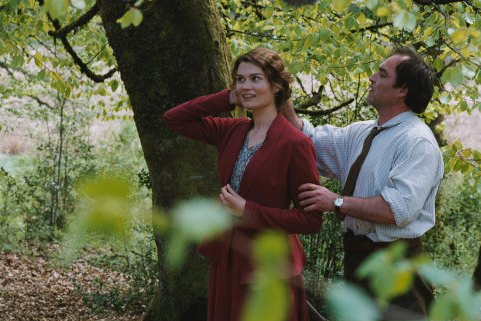
Wednesday, February 15, 2012

Biutiful

Film Watched: Biutiful dir. Alejandro Iñárritu

This is quite the heavy picture. It was very atmospheric with not too much levity, and it presents some very striking images and horrific moments. Not a film to watch if you're in a bad mood and if you are feeling good, get ready for that to end.

There are some beautiful scenes featuring Uxbal and his children! And then lots of death and despair.

The film prepares the viewer with clues shown throughout for the death of the main character, Uxbal. Which is what I will be exploring in this post more than anything else. There is a certain 'language' or style to death in Biutiful. The first possible aspect of this of this is that the dead must somehow converse with the living before they can move on. There are at last two examples of this.

  • when the ghost of a dead boy confesses his sins and the second is when the elderly man describes his death to his loved one. When Uxbal dies he finishes his conversation with his daughte. It seems to be his only loose end, the only thing unfinished in life. 
  • The spirits of the dead rise to the ceiling, which is perhaps first exibited through the moths and secondly through the bodies of the workers. Uxbal experiences this before he makes it to the bedroom. 
  • Those who have died can be seen in mirrors. Perhaps this is merely to emphasize the presence of a spirit because they cannot be seen outside of the mirrors in some shots, but it seems to be attached to the lore that Biutiful creates for the spirits of the dead.
The structure helps the film reveal many key points in the story in the story but guard their full meaning. The first time we see the man speaking to Uxbal in the forest we do not know his identity. In the beginning we are led to believe the father and daughter continue their conversation naturally, which we later realize, because of the change in perspective, is only half-true. He dies in the middle of their dialogue but she doesn't notice for two reasons.

  • She is fixated on her mother's ring which they were both admiring on her hand. 
  • She seems to have inherited her father's psychic or telepathic abilities and can continue the conversation with his spirit.

The film has been criticized for being too heavy handed and overly grim. As one reviewer points out, the film can give one, "a true overdose of the tragedy of the human condition". I found this to be the case where the Chinese factory owner, Hai, was murdered by his lover/business partner, Liwei. Compared to the death of the innocent immigrants this seemed no where near as important and a little bit overkill. It lacked the gravity that the other dramatic moments of the film had. Of course we know he's paranoid about someone talking, but to actually murder him? It seemed like an extreme moment used to nail in the idea that terrible things happen in life. Although the structure of the film is played with briefly (the beginning and the end) it remains comprehensible. One review described the film as Uxbal's "death march", which is essentially what the film captures. For the entire film, we know Uxbal as a man dying. The film explores the final struggles of a dead man walking.


-Claudia

Wednesday, February 8, 2012

Lady Chatterly Discussion

So in relation to what we discussed about Lady Chatterly in class I'd like to focus on a few points made that I thought were interesting. The first is that many people were describing Constance and Clifford's relationship as "traditional" but as two classmates pointed out, this is simply one perspective.


One classmate from Delhi pointed out that our view of their relationship is one that is a Western and American idea of traditional. Another classmate grew up in America, but in a household full of women so his perspective on this relationship that Constance is breaking free from wasn't that it was a traditional kind of situation. I think people expect that automatically Constance and Parkin being together because they fall in love would still be a kind of abnormal situation because of our own society's views on relationships. As the other students pointed out the ideals of love and relationships might not be so universal even though one of the main themes of the film is nature. I mention nature just because it seems like "the natural way to be" that would be universal.

Seeing the earlier version of Lady Chatterly's Lover was very funny. Immediately the class started laughing when the main menu of the DVD appeared because it featured Constance and Parkin who, in this version of the film are blonde, above average looking and giving the camera smoldering looks of desire. It brought to mind how subtle the French version of the film is.


                                                            Who are they looking at?

In Lady Chatterly (2007), the social and economic divides are important. However, in the 1993 serial these themes are beaten into the viewers minds as if we are not capable of inferring ideas presented to us in a less obvious manner. Perhaps because it was a made for TV film it was taken into consideration how the average viewer might be doing things with the TV on. So to make up for perhaps a less critical viewer, the creators of the film were less concerned with artistry and provoking thought.

The 1993 version of the film lays out the themes and characters on a silver platter with no room for interpretation. They are completely formed as characters and not as people. This approach not only gives the appearance of a soap opera but also distances the work from the audience. How could one possibly relate to this Constance, and this Parkin? Sure it's entertaining to watch an affair blossom but these shortcomings date the work and encourage disbelief in the story it's presenting.

-Claudia

Wednesday, February 1, 2012

Week Two Lady Chatterley

Week Two:

Film watched in class- Lady Chatterley (2007), Pascale Ferran


Lady Chatterley is a film that explores sexuality and nature. The owner of the Wragby estate, Sir Clifford Chatterley, is left disabled from an injury sustained in WWI. Clifton gives his wife, Constance, an encouraging speech on the forest filled grounds of their estate. He suggests that she find lovers who can please her in ways Clifton cannot. Constance is outraged at the thought of this and rejects the idea. As she later explains in her diary, "Sexual desire is the worst form of egoism."

The season is fall and the grounds of Wragby are introduced with shots of the clouds, the tops of trees and finally, Constance herself. This visually sets up the themes of the film, that of nature and the body.

In stark contrast to her slender form amongst the trees, we hear Clifton's mechanical wheelchair roaring over the classical film score. His presence is one separate from nature and humanity although his motives in the beginning seem more noble.

When asked to see the gamekeeper, Parkin, one afternoon, Constance stumbles upon the man himself bathing by the side of his cabin. Constance is extremely embarrassed and intrigued. She quickly finds a place where she can collect herself and still examine the gamekeeper's form.

Later that night Constance prepares for bed, which is located in a separate room from her husband. She sees herself in a mirror and undresses. Constance considers her naked body for a moment and then puts on her nightgown and goes to bed. In the middle of the night she wakes from a terrible dream and clutches her chest. Perhaps she dreamt of the gameskeeper and is physically affected by these new ideas of desire.

As Constance explores the grounds, where she seems to walk almost daily, she decides to spend time at Parkin's cabin in order to enjoy nature. She explains to him that it is beautiful and peaceful at the clearing where the cabin is and while he labors she sits back and relaxes.

Time passes and Constance and Parkin become more friendly. A pivotal moment occurs when they are tending to the newborn chicks in a chicken coop. As Constance holds a chick in her hand she remarks on how trusting it is and she begins to cry. She sees an admirable and natural quality of trust, so second nature to such a young being. However it is an aspect that she is separated from as she is not in touch with her sexuality. She merely flirts with it by enjoying nature on her walks around the forest which in A.O. Scott's review of the film describes as, "the sensuality of sunshine, wildflowers and fresh air." But she has never  before allowed access to the natural aspects of her own body. This is where Constance and Parkin connect and quickly have sex in the cabin. Their affair has just started.


An interesting aspect of their courtship is the formality of their sexual experiences in the beginning. They enter the cabin and do not disrobe. He only removes her stockings and underwear and the event lasts only a few awkward minutes. With each time they have sex, they ironically become more open to intimacy. A. O. Scott describes this journey as one that shows "how sexual chemistry can turn into love." Their removal of clothes is ritualistic and more is revealed with each interaction.

This slow reveal of each others bodies shows their strengthening bonds and trust for each other. Parkin is skeptical that Constance would find his body as appealing as he finds hers to be. Constance assures him that she has the desire to touch him. The night before Constance leaves on a vacation she asks to see him fully naked in front of her before he extinguishes the lights. This indulgence is a far cry from the Constance the audience is originally introduced to, proclaiming that, "Sexual desire is the worst form of egoism."

Another important moment occurs when Constance runs naked through the field and forest while it rains. She cries out to the skies and dances around freely. Parkin is infected by her joy and does the same. When they reenter the cabin they make crowns of leaves and branches. They decorate themselves with flowers all over their nude bodies. Their appearance and king and queen of nature is reminiscent of Adam and Eve in the Garden of Eden. They are able to return to a state where Adam and Eve were without shame. The pair are openly experiencing nature with no embarrassment towards their sexuality. It's a scene depicting a true marriage between nature and sex.


-Claudia

Tuesday, January 24, 2012

Week One La Jetée

Week One:

Film watched in class- La Jetée (1962), Chris Marker

My initial reaction to the film was divided. On one hand I felt a nice sense of completion and resolution as the title character reached the end of his journey and on the other hand I felt confusion at this "resolution".  The surprising twist bookmarks the beginning of the film and answers the question, "Who was the man on the Pier at Orly?"

But my confusion quickly follows and my certainty of what happened begins to fade. The protagonist himself speculates that he will see himself as a child as he has just been transported to a moment from his past. However we do not see this, the mise-en-scene is clear, we see the woman and an adult man at the end of the pier. Because of that I found it hard to pinpoint the logic, if there was any to be had, from the end of La Jetée. The main character saw a premonition of his future death but when he visits the memory he sees no boy. Does this mean that he, as a boy, experienced this event at all? Was this simply a prophetic dream, thought to be a memory?

The course is titled "Films about Love" and La Jetée tells the story of a man in love with a memory or a dream. He even realizes that the woman he spends time with is dead in his own time period. This does not  stop him from loving her memory, spending time with a phantom. Perhaps this is the residual devotion of a child, echoing from the time when he first saw her as a boy at Orly. He sees her as beautiful, but there is no real romance between them, only comfort and amicable conversation.

As mentioned in Jonathan Romney's article, La Jetée: Unchained Melody, the opening titles classifies La Jetée as a "photo-roman" or a "photo-book". He argues that since films are really just one still image after another in quick succession, La Jetée's sequence of still photos simply takes this concept and plays with the time involved. The idea of the film being a book also brings to my mind the idea that we "read" photos in order to decipher their meaning. The viewer has to read between the lines (or photos...) and participate more actively in viewing the film. This format eliminates the passivity of moving images.

-Claudia